Queanbeyan Museum runs on volunteers and we have an enthusiastic and skilled bunch but they are only human and can’t do everything! The Museum welcomes new members who can contribute their skills and knowledge and can learn new skills. Next training course is on Sunday 7th August 1-4 at the Museum.
Category Archives: History and Heritage News
The Song of Queanbeyan, 1938
Museum Musings- A QDHMS series published in the Queanbeyan Age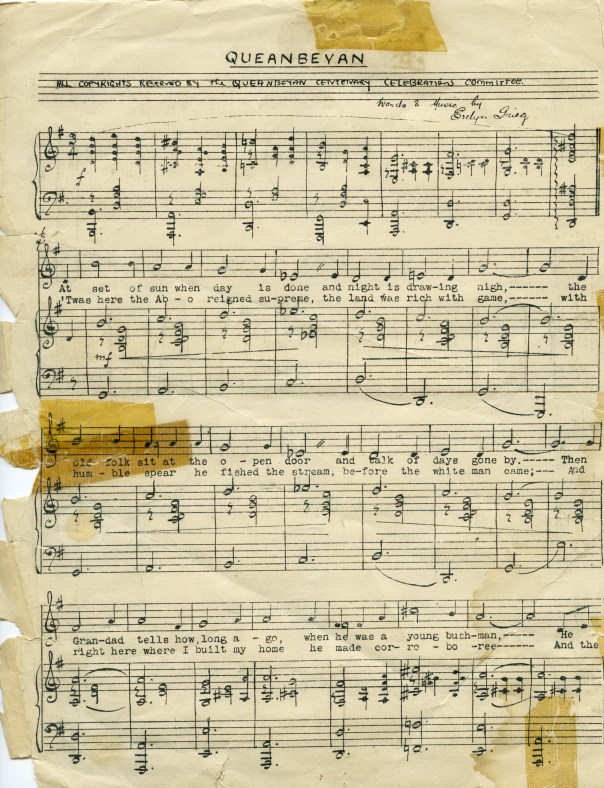
Queanbeyan Museum has valuable souvenirs of when Queanbeyan was a hundred years old. These are manuscripts and a recording of a song especially written for the occasion.
The recording, on a gramophone record called Queanbeyan Centenary Songs, sung and played by Jack Lumsdaine, has an interesting note: Donated by Mrs Roffe (Ruth) (daughter of Stan Mason) Mrs Roffe’s first job in 1941 was at 2CA. Feeling against Queanbeyan was such that when leaving the job, she was handed this record and told “here, you might as well take this with you”.
The Song of Queanbeyan was written in 1938 for the Centenary of Queanbeyan celebrations. It was one of a number of songs submitted to the Centenary Committee and chosen by them and subsequently copyrighted by the committee.
The song was written by Evelyn Grieg, who wrote several such themed songs, but signed the song over to the Mayor of Queanbeyan, John Esmond, and the Committee organising secretary, E. Colin Davis, for ten guineas.
Evelyn Grieg was a well known musician who wrote a number of similar songs such as The Song of Sydney, Our Land Australia and Australian Battle Cry (NLA MusicAustralia). She had been a vocal coach in New York and was a musical advisor at the ABC in Sydney.
The Song of Queanbeyan
Verse One
At set of sun when day is done,
and night is drawing nigh
The old folk sit at the open door
and talk of days gone by
Then Grandad tells how long ago
when he was a young bushman
He founded a homestead on the plain
at a place called Queanbeyan
Chorus
Queanbeyan, Queanbeyan,
I always long for you,
The open plains, the golden grain,
beneath the skies of blue,
Tho near or far where ere I roam,
Just like a boomerang,
I’ll always come back to the dear old home
in Queanbeyan
William and Nina Farrer’s Piano, c1890
Museum Musings- A QDHMS series published in the Queanbeyan Age

William Farrer of Lambrigg is famous for his development of rust resistant wheat, earning the title of “father” of the Australian wheat industry. In 1882 Farrer married Henrietta Nina the only daughter of Leopold Fane de Salis, the then Member of Parliament for Queanbeyan.
Queanbeyan Museum is fortunate to possess a piano belonging to Nina. The piano is a small upright piano made in the 19th century by A.H. Francke of Liepzig. External condition and detailing is good, with candle holders and carved legs all undamaged. The keys are all still intact, however the piano’s internal works are damaged. It is wood veneer and has a very attractive warm patina.
The piano is connected to a significant families in the early history of Queanbeyan and to Queanbeyan Museum, in its association of place, Nina’s father having been a Magistrate since 1844 and the Old Police Sergeant’s Residence being the only building left out of the complex of Government buildings that stood here: the Courthouse, police station and Post Office. The Museum is also connected to local commemoration of Farrer, being situated in Farrer Place which contains a bust of Farrer sculpted by Rayner Hoff.
 Queanbeyan Museum